Dyewitness // What Would You Like to Hear Again? (EP) (1993)
"He-ey babe!!"

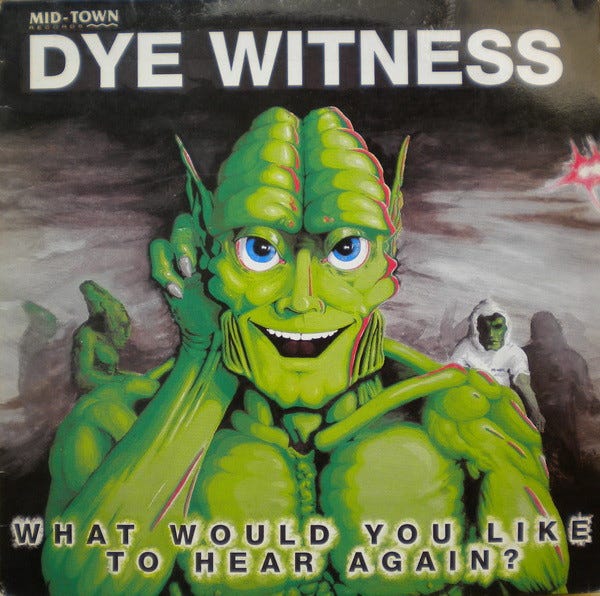
"What Would You Like to Hear Again?" feels, simultaneously, like a high-tech hymn for a millenarian utopia and the soundtrack to an 8-bit video game about the Marx Brothers. Fascinatingly, although the EP is an early entry in the gabber subgenre, the music already feels like a parody of itself: a series of hyperbolic, amphetamine-fueled anthems for a world on the brink.
The title song kicks off with a bizarre, repetitive vocal sample layered over a Looney Tunes-ish track that feels both silly and menacing. Hyper, buzzing bee noises compete with the frantic chirping of a smoke detector gone rogue, and the overall effect is that of a robot careening out of control. Things only get more manic from there. The EP is rich with drum machines frantically jockeying toward an imaginary finish line, thumping thuds reverberating across ear-splitting shrieks, classic vocal samples modulated into unfamiliarity, and absurd rhythmic squelching noises that sound like Cowboy Curtis plodding around in waterlogged boots. This is a record that *mogs* its listener.
Despite its forward-looking sonic profile, WWYLTHA feels charmingly DIY — as with all the best techno, you can sense the pulsating human heartbeat at the core of the machine. The mind behind Dyewitness was a young Rotterdam producer by the name of Mischa van der Heiden, and you can almost visualize his fingerprints on this EP. (In one interview, he talks about creating his earliest tracks by recording vinyl records to cassette and then cutting up the tape to create samples, so the fingerprints here may be physical as well as metaphorical!) The cover art looks like it was done by a high school student in the best kind of way (considering that van der Heiden was 21 when WWYLTHA came out, this may actually not be too far off the mark).
Like much European techno from this era, WWYLTHA features prodigious sampling from Black American artists — in this case, Public Enemy and Rhythm Controll — combined with borderline(?) obnoxious Eurotrash beats. Ultimately, Dyewitness feels like the endearing wigger little brother to Eurodance acts like Praga Khan and 2 Unlimited, wearing his influences on his snot-encrusted sleeve. In addition, the combination of DIY sensibility, menacingly upbeat energy, and tongue-in-cheek willful stupidity is reminiscent of what was going on in certain corners of European metal at the time; I'm specifically reminded of Antwerp-based mincecore pioneers Agathocles. I'm not sure if the gabber scene and the grindcore one had any overlap or if they just happened to share an era and approximate location, but as a fan of both it's fun for me to imagine them drinking from the same spiritual and creative well.
According to van der Heiden, the project was named after an "As Seen on TV" self-defense spray. In addition to temporarily blinding a would-be attacker and dying their face green for identification purposes, it would also apparently transform them into Jordy Verrill: